March 31, 2026

Managing Partner

Critical minerals strategy is no longer primarily a demand story; it is a supply-chain control story defined by who controls processing, permitting timelines, and offtake architecture.
The conversation about critical minerals in most boardrooms follows a familiar arc. Demand for lithium, copper, cobalt, and rare earth elements will grow three to four times by 2040. Clean energy and electrification are the drivers. The mines are concentrated in a handful of countries, which creates risk. That is usually where the analysis stops.
But that is the wrong place to stop.
Demand growth is real, well-documented, and, because every serious forecaster has published it, insufficient as the basis for a differentiated strategy. The question that actually determines whether a company will have reliable access to the inputs it needs, at prices it can plan around, is not how much the world needs. It is who controls the stages of the supply chain between geology and delivery: refining, processing, permitting velocity, and the contractual architecture of offtake. That is where supply shocks originate, where geopolitical leverage concentrates, and where the most sophisticated governments and industrial buyers are now intervening at a pace that most corporate strategies have not kept up with.
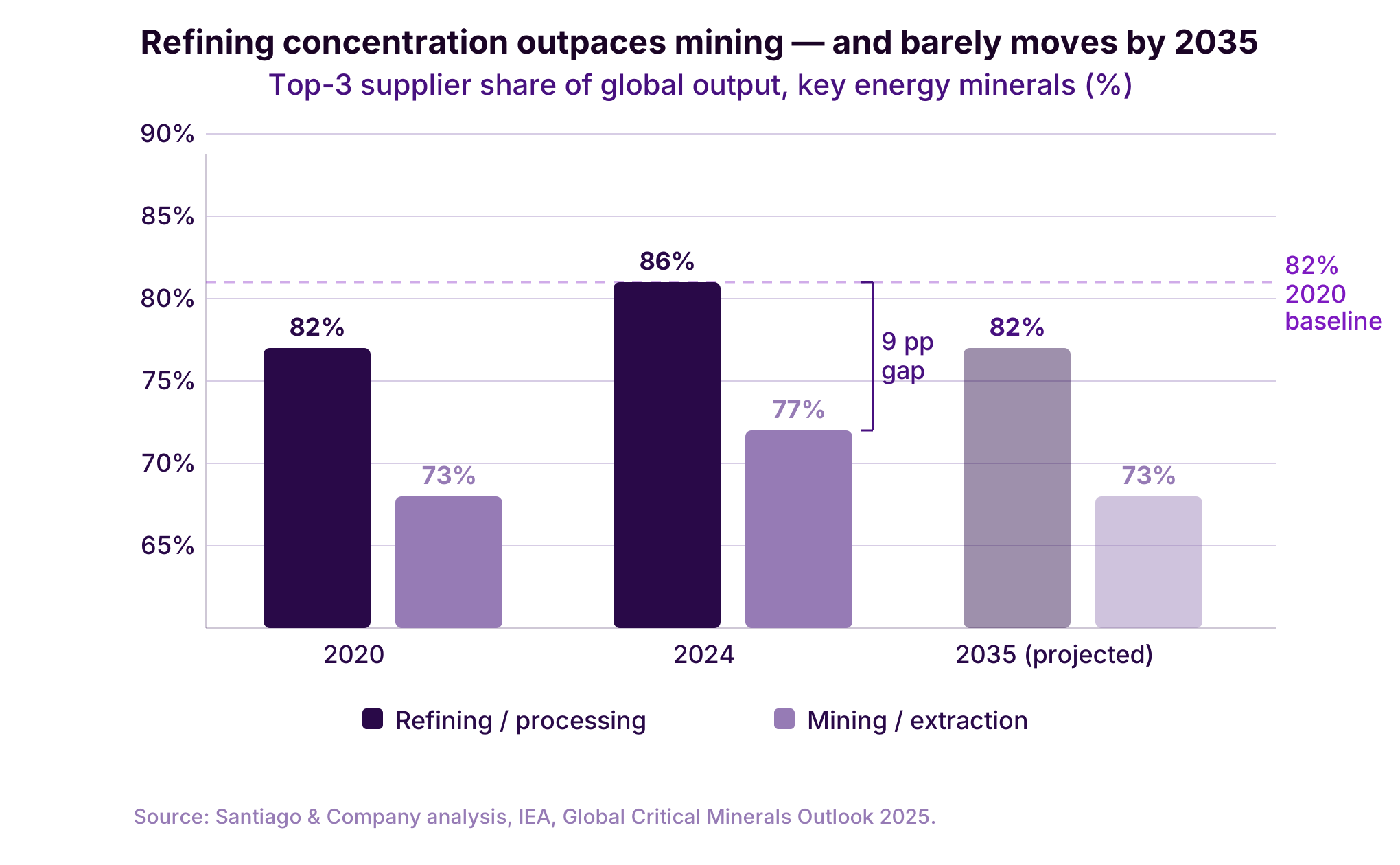
The International Energy Agency's 2025 Global Critical Minerals Outlook provides a clear picture of the structural landscape. For the six key energy-transition minerals copper, lithium, nickel, cobalt, graphite, and rare earth elements, the average market share of the top three refining nations reached 86 percent in 2024, up from 82 percent in 2020. The top three mining nations held 77 percent of mining output over the same period, up from 73 percent. The nine-percentage-point gap between refining and mining concentration is not incidental; it reflects how much harder it is to replicate processing capacity, specialized chemistry, accumulated expertise, regulatory tolerance, and decades of capital investment than to open a new pit.
More telling than the current figures is the trajectory. Based on announced projects and current policy settings, the IEA projects that the average top-three refining concentration will decline only marginally to 82 percent by 2035, effectively returning to the 2020 baseline despite a decade of diversification rhetoric and significant new policy commitments. Processing concentration is structurally sticky in a way that mining concentration is not.
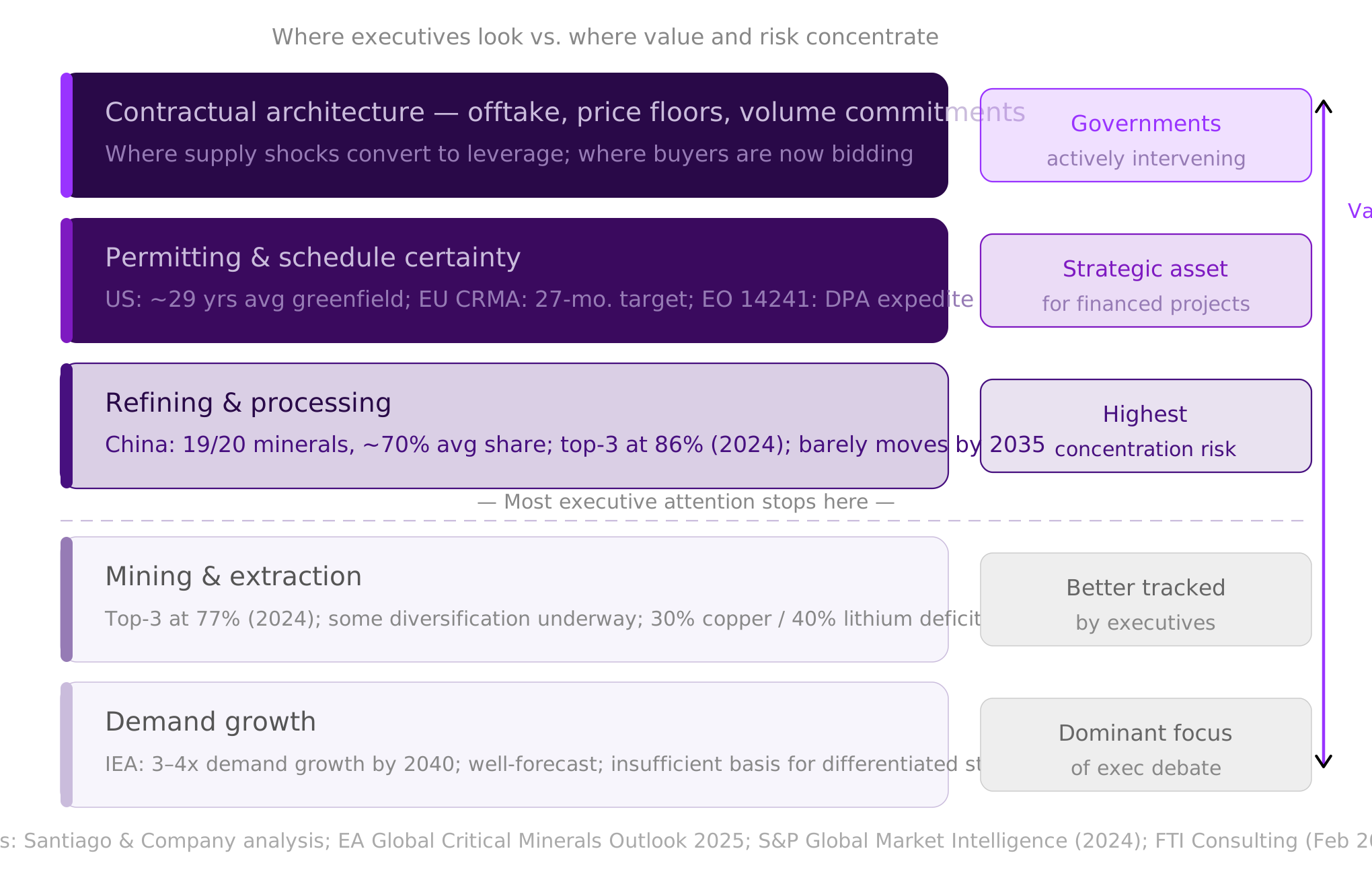
Behind the aggregate figures sits a more concentrated reality. China is the leading refiner for 19 of the 20 strategic minerals the IEA closely tracks, with an average refining market share of around 70 percent. For gallium, graphite, manganese, and rare earth elements, China's share of refining exceeds 90 percent. Capital costs for processing projects in non-incumbent regions run approximately 50 percent higher than in established centers, according to IEA analysis, which is precisely why new capacity is slow to materialize even when demand signals are strong.
This is not a geopolitical hypothesis. It is an industrial reality that China demonstrated, with measurable consequences, in 2025.
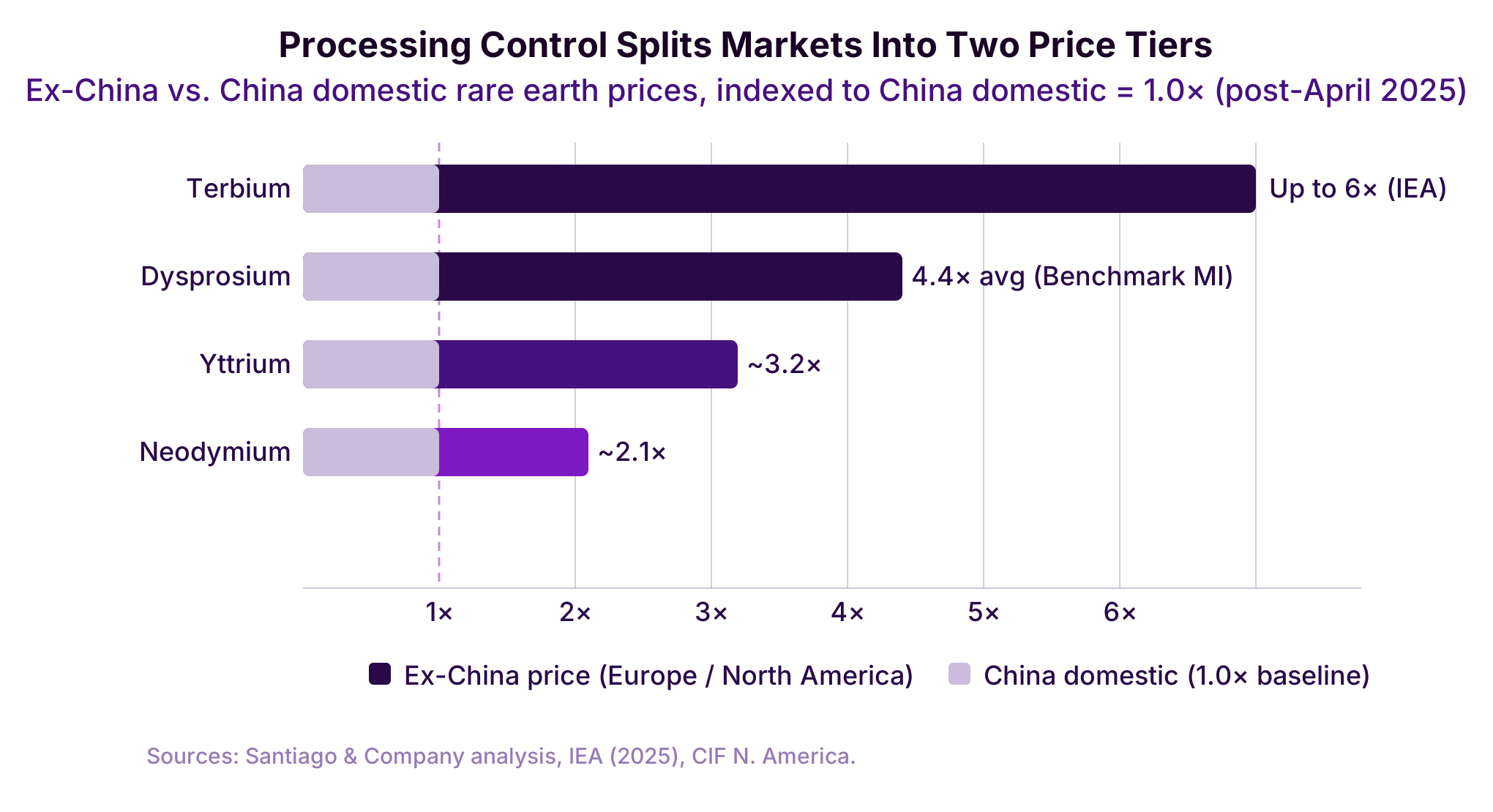
On April 4 of that year, China imposed export licensing requirements on seven heavy rare earth elements: samarium, gadolinium, terbium, dysprosium, lutetium, scandium, and yttrium, along with their compounds, metals, and permanent magnets. The mechanism was not a ban; it was a licensing requirement, with a 45-day processing period, applied to materials that flow through Chinese refineries before reaching manufacturers in the United States, Europe, and elsewhere. Within weeks, the effects were industrial rather than theoretical. European rare earth prices reached up to six times those in China for the most affected elements, according to IEA analysis, with Benchmark Mineral Intelligence independently reporting a sustained 4.4 times premium on dysprosium oxide for North American buyers. Ford Motor Company shut its Chicago Explorer assembly plant for a week; its CEO described the supply situation as "hand-to-mouth." European automotive supplier association CLEPA reported factory shutdowns and production line halts across member companies.
What made the 2025 episode particularly instructive was what happened in November. First, China announced an expansion of controls to 12 rare earth elements and processing equipment, which would have constrained other countries' ability to build independent refining capacity. Then, on November 7, in an agreement with the United States, China suspended those expanded measures before they took effect. This suspension is not evidence that the controls failed; rather, it is evidence that they worked as intended: Beijing demonstrated its capability, extracted trade concessions in return for restraining it, and left the architecture intact for possible reimposition. The controls were suspended, not dismantled. The underlying refining concentration that makes them effective has not changed.

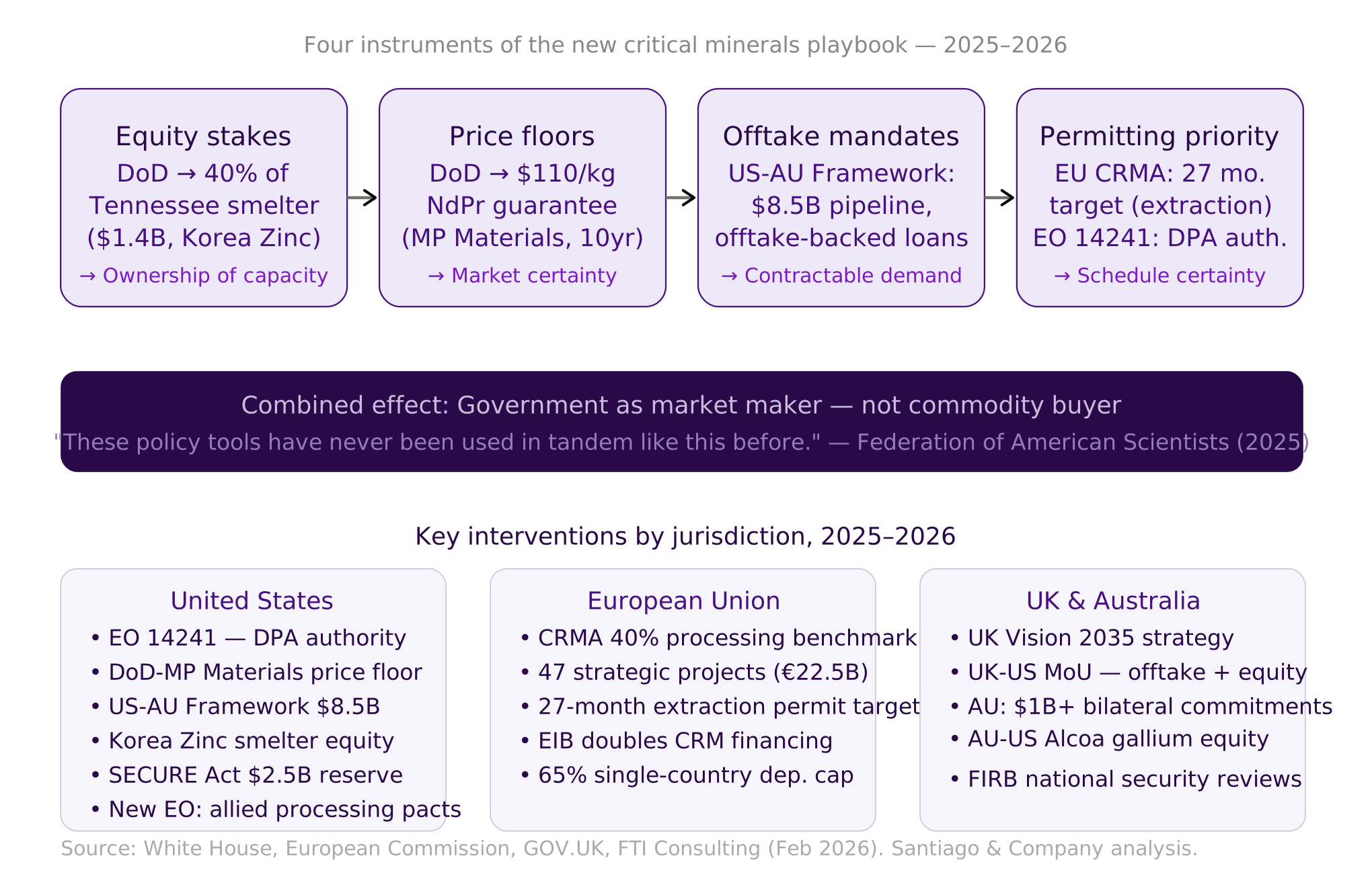
The policy response in the United States, European Union, United Kingdom, and Australia over the eighteen months from mid-2025 to early 2026 does not resemble a conventional procurement effort. Instead, it resembles an attempt to build a second market from scratch—one with different ownership structures, different price certainties, and different contractual terms than the market China has developed over three decades of industrial strategy.
The United States has moved furthest and fastest. Executive Order 14241, signed in March 2025, invoked Defense Production Act authority, the same authority used for military procurement during wartime, for domestic mineral production and processing. The Department of Defense has taken direct equity positions in processing facilities. Its agreement with MP Materials, finalized in July 2025, involved a $400 million equity investment and a $150 million loan, combined with a 10-year price floor guarantee of $110 per kilogram for neodymium-praseodymium oxide, nearly double prevailing market prices at the time, and a commitment to purchase 100 percent of the facility's 7,000-metric-ton annual magnet output. The Federation of American Scientists' analysis was direct: "These policy tools have never been used in tandem like this before." In December 2025, the Pentagon took a 40 percent equity stake in a $7.4 billion polymetallic smelter in Tennessee, the first new zinc smelter built in the United States since the 1970s, as part of a joint venture with Korea Zinc. In January 2026, bipartisan sponsors in both chambers of Congress introduced the SECURE Minerals Act, which would authorize $2.5 billion for a Strategic Resilience Reserve Corporation with authority to purchase critical minerals at above-market prices, crowding in allied co-funding alongside domestic stockpiles.
The bilateral architecture has moved in parallel. The US-Australia Critical Minerals Framework, signed in October 2025, commits both governments to mobilize at least $1 billion each in financing within six months, against a joint project pipeline valued at $8.5 billion, with explicit commitments around offtake-backed loans, equity participation, and streamlined permitting. The US Export-Import Bank announced more than $2.2 billion in letters of interest for Australian projects within weeks of the Framework's signing. In February 2026, the United Kingdom and the United States signed a memorandum of understanding that explicitly commits both governments to mobilize financing through "guarantees, loans, equity investments, and the finalization of offtake arrangements" not commodity purchases, but supply-chain architecture. A new US executive order issued in March 2026 directed the Secretary of Commerce to negotiate processing and refining cooperation agreements with foreign partners, authorized trade remedies if negotiations fail, and explicitly cited domestic mining without domestic processing as an insufficient response to national security risks.
The European Union's Critical Raw Materials Act establishes its own set of structural targets: 40 percent of EU annual consumption processed domestically by 2030, a 65 percent single-country dependency cap at any stage of the supply chain, and permitting timelines of 27 months for extraction projects and 15 months for processing projects. Whether those targets prove achievable is a separate question; current EU permitting timelines run significantly longer, and independent analysts at the Overseas Development Institute note that the financing commitments fall well short of what the targets imply, but the directional intent is clear. The EU is not trying to buy more minerals. It is trying to own more of the processing architecture.
The emerging policy architecture changes what matters in project evaluation and, therefore, in capital allocation and portfolio strategy in ways that most corporate financial models have not yet incorporated.
Consider permitting. S&P Global Market Intelligence's 2024 study of 268 mine projects found that the United States has the second-longest mine development timeline in the world at nearly 29 years on average from discovery to first production, behind only Zambia at 34 years. Canada averages approximately 27 years; Australia, approximately 20 years. The US figure reflects cumulative permitting complexity on federal lands, litigation risk, and sequential regulatory processes, not geological difficulty. A mine project with geological merit but an uncertain permitting path is not a strategic asset; it is an option on a strategic asset, with a 15-to-20-year exercise window. What governments are now offering, through expedited permitting mechanisms, DPA authority, and strategic project designations, is compression of that window. Projects that can demonstrate a credible path to production within a policy-relevant timeframe close enough to matter for the 2030 targets that frame most net-zero and national security commitments will attract a financing premium over those that cannot.
Offtake structure is the related constraint. The principle in project finance has long been clear: lenders typically require that between 60 and 80 percent of future production be committed through long-term contracts before construction financing is approved. The US Department of Energy's $2.26 billion loan to Lithium Americas' Thacker Pass project followed GM's commitment to a 20-year offtake agreement for the entirety of Phase 1 production. The sequence was not coincidental. GM's offtake converted an optionality story into a bankable project; the DOE loan followed the bankability, not the geology.
The structure of the most significant offtake deals, however, reveals an important distinction. The government's price-floor model, in which DoD pays a guaranteed $110 per kilogram regardless of market price, is a deliberate market-making instrument designed to sustain domestic processing capacity through commodity price cycles. Most private-sector OEM agreements work differently. GM's Thacker Pass deal uses market-linked pricing formulas. Ford's cluster of agreements with Albemarle, Ioneer, Nemaska, and BHP spans longer durations than historical spot contracts and sometimes combines equity participation with volume commitments, but they remain tied to market prices rather than floors. Tesla's agreement with Liontown Lithium revised pricing against spodumene indices in 2025. The direction is consistent across both government and private deals, away from spot procurement and toward longer-duration contractual commitments that provide planning certainty, but the mechanisms differ. Government deals are setting price certainty; OEM deals are setting volume certainty. Both create a structural preference for projects that can deliver contractable supply with credible timelines, relative to projects that can only offer geological optionality.
The implication, as CSIS analyst Gracelin Baskaran testified before a House subcommittee in March 2026, is that the supply chain must be understood as a vertically integrated system: "A mine without a refinery, a refinery without a manufacturer, and a manufacturer without a customer are each stranded assets." What governments and sophisticated industrial buyers are now doing, combining equity stakes, offtake commitments, price support, and permitting priority in single packages, is building the integrated systems that spot markets and fragmented project finance have historically failed to produce.
The executives most exposed to this structural shift are those whose critical mineral procurement still relies primarily on market pricing and short-duration contracts, who have not yet stress-tested their supply chains against an N-1 scenario, which is what happens if the dominant refining country is removed from the equation, and who have not mapped where in their supply chain permitting risk and processing concentration intersect.
The IEA's N-1 analysis is instructive on this last point. For graphite and rare earth elements, supplies from all sources, excluding China, would cover only 35-40% of the remaining global demand in 2035. For nickel, the figure is below 55 percent. These are not disruption scenarios; they are the structural baseline for what a supply shock under refining concentration actually implies. An executive whose supply chain depends on Chinese processing for rare-earth magnets, graphite anode material, or lithium battery chemicals should not be thinking of diversification as a long-term aspiration. They should think of it as a present-tense exposure.
Three questions sharpen the decision. First: what percentage of your critical mineral inputs are covered by contracts longer than five years with processors outside China? If the answer is less than 20 percent, you are not managing supply-chain risk; you are deferring it. Second: for the projects you consider part of your supply security strategy, do you have a credible line of sight to permitted production within the current decade? Geological optionality on a 15-to-20-year timeline does not address supply security for 2030 objectives. Third: have you engaged with the public financing mechanisms DFC, EXIM, DPA authority, and CRMA strategic project status that can change the economics of a project your supply chain depends on? The companies best positioned in this space are not those with the largest mineral reserves in their portfolio. They are those that have integrated supply-chain architecture, contractual certainty, and public-private financing into a coherent strategy.
The fundamental error in the dominant framing is treating critical minerals as a commodity play that depends on price and demand. It is a supply-chain control play that depends on who owns the processing, who holds the offtake, and who has the permitted project that can deliver in a politically relevant timeframe. Governments figured this out in 2025. The executives who figure it out in 2026 will have options; those who are still running demand models in 2028 will be negotiating from a position of structural disadvantage
IEA, Global Critical Minerals Outlook 2025, May 21, 2025. Executive Summary, "Overview of Key Minerals," "Policy Mechanisms for Diversified Mineral Supplies," and "Broader View on Energy-Related Strategic Minerals."
IEA, "With new export controls on critical minerals, supply concentration risks become reality," Tae-Yoon Kim et al., October 2025.
IEA, "Designing an effective strategic stockpiling system for critical minerals," January 2026.
White House, Executive Order 14241: "Immediate Measures to Increase American Mineral Production," March 20, 2025. whitehouse.gov/presidential-actions
White House, "United States-Australia Framework for Securing of Supply in the Mining and Processing of Critical Minerals and Rare Earths," October 20, 2025.
CSIS, "New Executive Order Ties U.S. Critical Minerals Security to Global Partnerships," Gracelin Baskaran, March 2026.
Federation of American Scientists, "Unpacking the DoD and MP Materials Critical Minerals Partnership," Alice Wu, July 2025.
S&P Global Market Intelligence, "Mine development times: The US in perspective," Bonakdarpour, Hoffman, Rajan, June 2024. Commissioned by National Mining Association.
S&P Global Market Intelligence, "From 6 years to 18 years: The increasing trend of mine lead times," 2025.
European Commission, Critical Raw Materials Act, Regulation (EU) 2024/1252.
GOV.UK, "UK and US sign Memorandum of Understanding on critical minerals," February 4, 2026.
Benchmark Mineral Intelligence, "Ex-China rare earths premium to grow, especially for heavies," 2025.
ODI, "Critical minerals geopolitics in 2026: risks, supply chains and global power shifts," Olena Borodyna, January 2026.
Deloitte US, Mining & Metals Industry Outlook 2026.
CNBC, "Pentagon takes big stake in new Korea Zinc smelter in Tennessee," December 15, 2025.
Congress.gov, SECURE Minerals Act of 2026 (H.R. 7126 / S. 3659), 119th Congress, introduced January 15, 2026.



Aerospace and defense companies will convert record demand into revenue only by managing qualified throughput. The scarce asset is qualified throughput, and it has to be managed node by node. The approved combination of site, process, workforce, and part at the individual production-node level.
Santiago & Company announced the public release of the AI Workforce Stability Architecture (AWSA) at the United Nations WSIS Forum 2026, introducing an open framework that helps governments monitor, prepare for, and respond to the economic and fiscal impacts of AI-driven labor displacement in service-export economies.
AI is moving on a 15-month clock; governments are moving on a five-year one. For service-export economies, the winners will not be those that forecast labor disruption most precisely, but those that pre-wire fiscal and workforce responses before the evidence becomes undeniable
SpaceX does not need to disrupt the wireless industry to reshape it. By turning satellite coverage into negotiating leverage, it is forcing carriers to rethink who owns the customer relationship when coverage comes from space.