April 1, 2026

Managing Partner

The 2026 helium disruption is not fundamentally a war story or a supply-chain story, but a governance failure: companies that treated helium as a strategic utility can absorb the shock, while those that treated it as an ordinary commodity are now exposed to prolonged operational risk.
Iranian drones struck Qatar’s Ras Laffan complex on March 2, 2026. This didn’t cause the helium crisis; it revealed the boards' refusal to act. QatarEnergy declared force majeure two days later. One-third of global helium vanished from the market in a matter of hours. Spot prices doubled in weeks. Over 200 cryogenic shipping containers were instantly stranded in a war zone. South Korean chipmakers, sourcing 64.7% of their helium from Qatar, scrambled to pay premiums for U.S. supply, aware that their inventory would last for 4 to 6 months. Hospitals worldwide saw immediate helium cuts of up to 50%.
The conventional account frames this as a supply chain disruption caused by a geopolitical shock. It’s the same story told about Taiwanese chip concentration, Ukrainian neon in 2022, or rare-earth dependence on China. That framing is technically accurate and strategically useless. It explains the trigger but not the damage. Geopolitical shocks happen. The question is why this one regional military conflict, fought over unrelated issues, could threaten semiconductor production, defer cancer diagnoses, and ground aerospace programs across four continents.
The evidence points toward an uncomfortable but correctable conclusion. The primary difference between organizations managing inconvenience and those managing crisis is governance, not geography. Organizations that absorb this disruption at an acceptable cost share a trait: they classify helium as a strategic asset, not a commodity. It is a non-substitutable input with a fragile supply, requiring a different management posture. In contrast, those in crisis classified helium as a procurement line item. They applied standard commodity logic: price-optimization, single-sourcing for convenience, a week of inventory, and trust in a supply chain never architected to withstand shocks.
This misclassification is, in our analysis, the main correctable failure discussed here. It is fixable, but not after a ceasefire. The structural reasons helium is a strategic utility endure after hostilities stop and may worsen. The required governance can be learned from organizations that succeeded, if others are willing to study their approach.
Three physical and structural conditions define a strategic utility and distinguish it from a conventional commodity input. The evidence from public sources and primary data supports the conclusion that helium consistently and measurably satisfies all three, including its most critical industrial applications, without a credible substitute.
The first condition is functional non-substitutability. A commodity input can be replaced, substituted, or reformulated when supply tightens. Helium cannot be used in the applications where it is most indispensable. The gas boils at 4.22 Kelvin, colder than any other element at standard pressure, and this property cannot be reproduced by any other substance. In semiconductor manufacturing, it cools ASML’s extreme ultraviolet lithography systems, which generate enormous heat during sub-7-nanometer patterning; its thermal conductivity is approximately six times that of nitrogen, and its chemical inertness means it will not react with the ultra-pure materials involved. It serves as the carrier gas during chemical vapor deposition. It enables helium mass spectrometry leak detection at precision levels no substitute achieves. It dissipates heat during ion implantation, injected between the wafer and the electrostatic chuck hundreds of times per wafer. The U.S. Geological Survey states plainly in its 2026 Mineral Commodity Summaries that nothing substitutes for helium in applications requiring temperatures below- 429 degrees Fahrenheit. Professor Jong-hwan Lee of Sangmyung University put it to the Associated Press directly: “Under current semiconductor manufacturing processes, there’s no viable replacement for helium to cool wafers.” In healthcare, liquid helium cools the superconducting magnets in MRI machines to approximately -269 degrees Celsius. The technology for helium-free MRI exists. Philips has installed over 2,000 BlueSeal scanners that use 7 liters rather than 1,500, but it applies only to new machines. The approximately 50,000 conventional helium-cooled scanners currently operating worldwide cannot be converted; for them, an uninterrupted helium supply is an operational requirement, not a preference. The acute impact on any specific facility will vary by service model, installed base age, and the allocation response of its gas supplier, but the directional dependency is the same across the installed base.
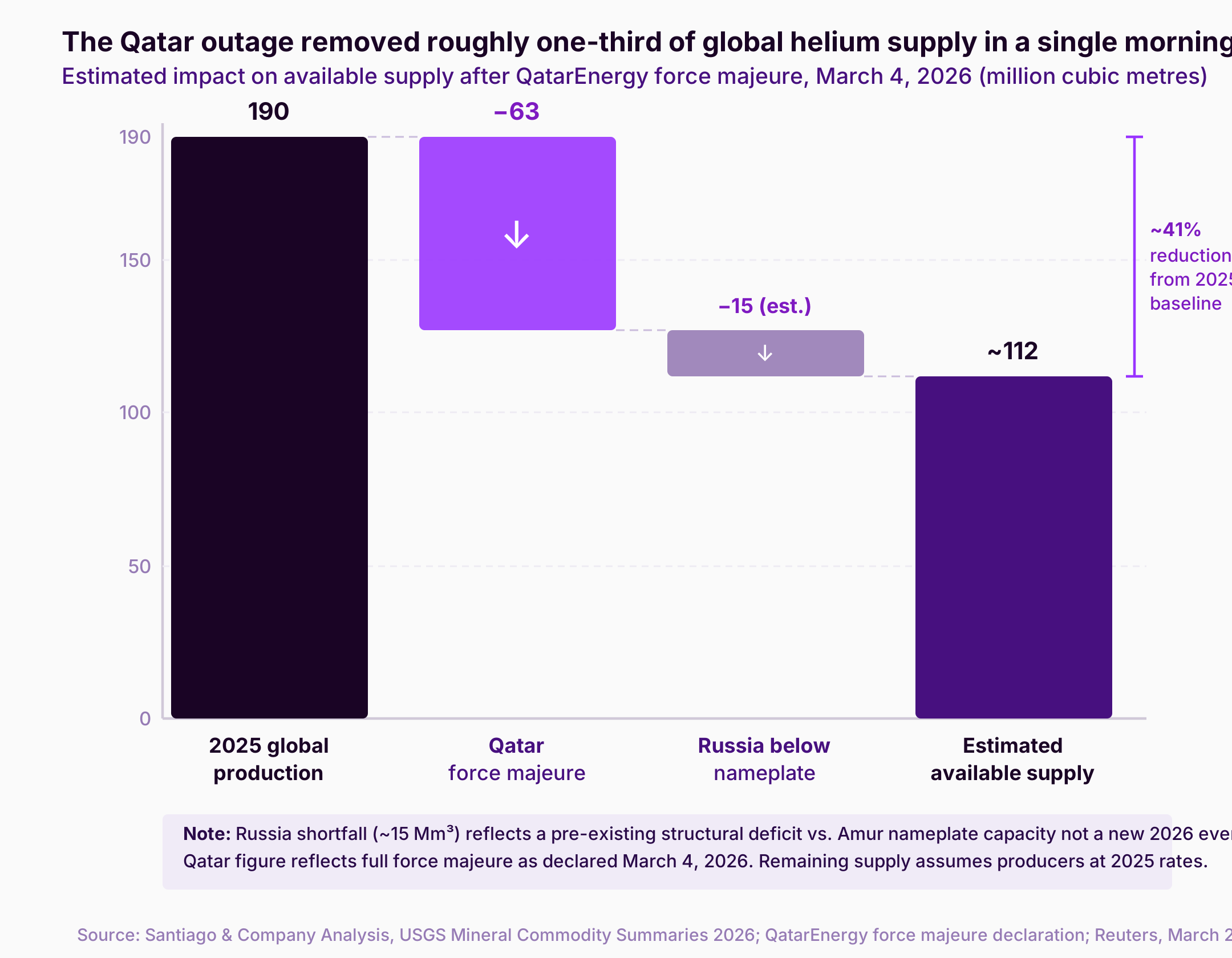
The second condition is severe supply concentration. A commodity input sourced from many competing producers across multiple geographies naturally offers resilience through redundancy. Helium has no such resilience. According to the USGS, global production in 2025 reached approximately 190 million cubic meters. Two countries produced 76% of that total: the United States at 81 million cubic meters and Qatar at 63 million. Russia, which was supposed to become the third major pillar through the Gazprom Amur Gas Processing Plant, designed for 84.5 million cubic meters of annual capacity, has been crippled by fires in October 2021 and January 2022, Western sanctions restricting equipment imports, and chronic underperformance, leaving it contributing approximately 18 million cubic meters against a nameplate potential three times that size. The remaining global supply comes from Algeria, Canada, China, Poland, and a handful of smaller producers. There is no swing producer. There is no uncommitted capacity awaiting activation. When one node of this system fails, there is no reserve tap to open.
The third condition is a structural unstorable nature. Most industrial inputs can be physically stockpiled to mitigate supply disruptions. Oil goes into strategic petroleum reserves. Rare earths go into government stockpiles. Even semiconductor chips can be warehoused in increasing quantities as inventory buffers. Liquid helium cannot be stored at scale by any practical technology. It boils at 4.22 Kelvin, and the best cryogenic ISO containers available, manufactured almost exclusively by Gardner Cryogenics, which has produced over 97% of the world’s liquid helium transport vessels since 1973, experience continuous boil-off, rendering their cargo inert within 35 to 45 days. There is no tank farm. There is no cavern reserve. The U.S. Federal Helium Reserve, which once held more than a billion cubic meters, was fully privatized in January 2024 when the Messer Group purchased the Cliffside Storage Facility and its associated pipeline infrastructure for $460 million. The USGS now records the government helium stockpile as “None.” No other government in the world maintains a strategic helium reserve. The physics make it prohibitive, and the policy frameworks have not developed an alternative.
These three conditions, non-substitutable function, concentrated supply, and structural non-storability, define what this article calls a strategic utility: an input that performs a specific, irreplaceable role in critical production processes, exists in a supply system with minimal redundancy, and cannot be buffered by conventional inventory management. Standard commodity procurement logic, which assumes some substitutability, some supply diversity, and some ability to build protective inventory, does not apply. Applying it to helium produced the exposure map that became visible on March 4, 2026.
The governance failure is most visible not in the scale of the 2026 disruption but in the consistency of the pattern that preceded it. The helium market has been structurally fragile since commercial production began scaling in the late 1990s, and that fragility has expressed itself repeatedly, at predictable intervals, in ways that any organization paying attention should have incorporated into its risk framework long before March 2026.
Helium Shortage 1.0 arrived in 2006–2007, when new production plants came online more slowly and at lower capacity than anticipated. The shortage caused price spikes and a complete supply cutoff for some buyers, including research institutions and hospitals, which were deprioritized when distributors implemented allocation. Shortage 2.0 ran from 2011 to 2013, driven by maintenance shutdowns at U.S.-based plants and economic disruptions in Europe. Shortage 3.0 emerged in 2018–2019, triggered by production problems that coincided with rising demand from the semiconductor industry. A brief respite followed during COVID-19 as demand fell, but that masked the underlying structural deficit. Shortage 4.0 began in January 2022 and proved the most severe of the pre-2026 era: the Amur Plant explosions prevented the Russian supply surge that was supposed to resolve market tightness, planned maintenance in Qatar removed additional capacity, and all four of the world’s largest helium distributors Air Liquide, Linde, Matheson, and Messersimultaneously declared force majeure and implemented supply rationing for their contract customers. Helium costs rose between four and ten times over the preceding decade at many institutions. Blue Origin, a Finnish cryogenics company, documented that between 2006 and 2022, there were eight separate periods of supply deficit over 17 years.
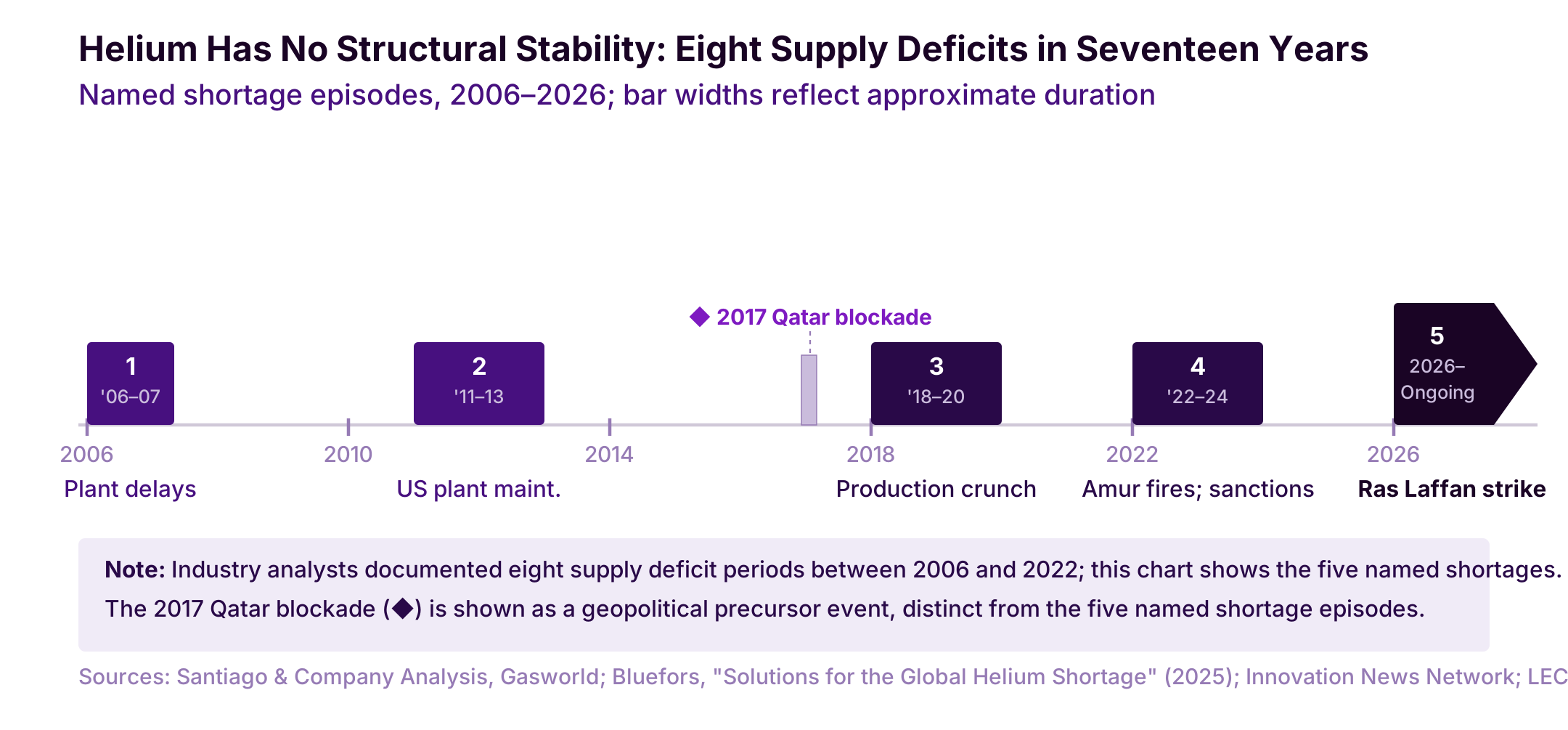
Eight deficits in 17 years is a recurrence rate of roughly one major shortage every 2 years. This is the behavior of a no-slack system with concentrated production, inadequate spare capacity, and no buffering reserve, exactly as expected. The 2026 event is the largest and most severe in this sequence, but it is not anomalous. It is the system expressing its structural character at the highest intensity yet observed. An executive who classified helium as a commodity subject to normal procurement risk management after observing five named shortage events in twenty years made an analytical error, not an unlucky bet.

The assumption that a ceasefire will restore helium supply is the most consequential misunderstanding in current corporate planning. It conflates ending the trigger with resolving the disruption. The structural damage inflicted by the Ras Laffan attack will persist long after any hostilities cease, through three distinct mechanisms that operate on different timescales, none of which is resolved by a political agreement.
The first mechanism is permanent physical damage to production infrastructure. The March 18–19 missile strikes on Ras Laffan destroyed LNG Trains 4 and 6, joint ventures between QatarEnergy and ExxonMobil, as well as Shell’s Pearl Gas-to-Liquids facility. QatarEnergy CEO Saad al-Kaabi confirmed that 12.8 million tonnes per annum of LNG capacity, approximately 17% of Qatar’s total, would be offline for three to five years. The two damaged trains collectively cost approximately $26 billion to build. Their restoration requires not simply repair but the reconstruction of specialized infrastructure and the procurement of large-frame gas turbines from a global market, where Rystad Energy notes that the three manufacturers of such equipment already face stretched order books from data center construction and coal retirement programs. QatarEnergy disclosed that even after all undamaged trains resume operations, annual helium output will be permanently reduced by approximately 309.54 million cubic feet, a 14% structural reduction in Qatar’s helium capacity until the new trains are rebuilt. The undamaged 86% of Qatari capacity requires, for its own restart, a security environment that satisfies insurers willing to cover Gulf shipping, a logistics workforce willing to return to the site, and a cryogenic equipment supply chain capable of mobilizing at scale. None of these conditions is established by the act of a ceasefire. Fitch Ratings, placing Qatar’s AA sovereign rating on negative watch on March 30, noted that even if the Iran war ended within a month, the security environment for Qatar had “more permanently deteriorated,” and that $20 billion in annual revenue losses would only be “partly compensated” by elevated energy prices.
The second mechanism is logistics dislocation, which unwinds slowly regardless of the political resolution. Approximately 200 specialized cryogenic ISO containers, a significant share of the global cryogenic fleet, which industry analysts estimate at 500-700 vessels, are stranded in or around Qatar. These vessels are not interchangeable with any other shipping container. They are precision-engineered to maintain temperatures near absolute zero, manufactured almost exclusively by Gardner Cryogenics, and take months to reposition once their routing is disrupted. Phil Kornbluth, the most widely cited helium market analyst in the industry, has stated the arithmetic explicitly: however long a helium production shutdown lasts, add at least two months for logistics to normalize afterward. Richard Brook, CEO of Garrison Ventures, has described the eventual surge in container repositioning as “extremely disruptive,” with hundreds of vessels simultaneously attempting to reenter normal routing, overwhelming the coordination capacity of a market already operating with minimal slack. This is not a problem that a ceasefire resolves. It is a problem that begins to be worked on after a ceasefire and takes months to unwind.
The third mechanism is the physical loss of the helium that was already in motion at the time of the disruption. Liquid helium stored in cryogenic ISO containers has a maximum holding window of 35 to 45 days before boil-off renders the cargo unusable. Any container filled before the March 4 force majeure declaration that could not be delivered has already lost its contents to the atmosphere. There is no recourse. The gas is gone. Rebuilding the pipeline to physically fill the volume of helium in transit between production nodes and consumers at any given moment requires weeks of continuous production, even under ideal logistics conditions. This loss cannot be recovered; it can only be replaced by new production.
The net result is that even under an optimistic scenario ceasefire within weeks, security conditions adequate for workers to return, logistics coordination beginning immediately the helium market is short approximately 15% of global demand for the remainder of 2026 and likely well into 2027, reflecting the permanent loss from Trains 4 and 6, the inability of Russia to compensate given Amur’s structural constraints, and the absence of any government buffer reserve. The distributors entered the crisis with above-normal channel inventory, the legacy of an oversupplied market in 2024 and early 2025. That buffer is being consumed now. When it is exhausted, as multiple analysts project will occur between May and July 2026, the physical shortage will begin to manifest at the operational level in facilities that assumed the supply chain would normalize before it mattered.
The exposure is not uniform. The most vulnerable sectors and geographies are those where helium performs its most non-substitutable functions and where procurement practices most closely reflect commodity logic.
Semiconductors represent the highest-stakes exposure. The gas performs four functions in chip fabrication: cooling EUV lithography systems, acting as a carrier gas in deposition processes, enabling leak detection at precision levels no alternative achieves, and dissipating heat during ion implantation. None of these has a practical alternative at the production scale modern fabs require. Helium currently accounts for approximately 24% of global consumption, a share projected to reach 30% by 2030 as EUV adoption expands and chip geometries continue shrinking. Each advanced TSMC fab consumes roughly 500,000 cubic feet of helium annually.
South Korea is the most exposed geography. Samsung Electronics and SK Hynix, which together supply approximately two-thirds of the world’s memory chips, sourced 64.7% of their helium from Qatar in 2025, according to the Korea International Trade Association. Reuters reported on March 31 that both companies hold 4 to 6 months of inventory in their supply chains. The South Korean government confirmed it is paying premiums to access U.S.-origin helium, with Northeast Asia spot prices reaching $152.70 per thousand cubic feet in March 2026, a 21.5% premium over December levels and the steepest regional increase globally. This inventory figure, however, is misleading at the operational level: working inventory at most fabrication facilities amounts to roughly one week of supply, because cryogenic helium cannot be safely stored in bulk at a fab site. The supply chain buffer exists in the distribution network, not at the point of use. When that buffer depletes, individual fab lines will feel the shortage immediately, not gradually. Taiwan’s position is materially better because TSMC applied a different sourcing logic. Industry analysts and public reporting indicate that the company balances supply across at least three non-correlated geographies, including the United States, Gulf producers, and other suppliers, with no single source accounting for a majority of its volume. It maintains an operational buffer stock of over two months. Air Liquide opened a new helium facility in Taichung in late March 2026, part of more than €1 billion invested in Taiwan’s semiconductor gas infrastructure since 2019. The difference between South Korea’s exposure and Taiwan’s is not one of luck or geography; our analysis concludes it is one of governance. TSMC appears to treat helium as a utility with diversification requirements; the structure of its supply agreements and infrastructure investments reflects that classification.
AA's reasonable counterargument holds that the semiconductor industry is more adaptable than the above implies: sophisticated supply managers can reroute supply, pay premiums to access alternative sources, and triage production toward their highest-margin lines even under significant strain. This is correct in the near term and wrong in the medium term, and the distinction is important. For as long as supply exists somewhere in the market at any price, the industry’s response will look like managed stress, paying more for U.S.-origin helium, adjusting production priorities, and drawing down distributor inventory.
The South Korean inventory buffer, estimated at 4 to 6 months at the supply chain level, provides exactly this window. The failure mode described in the article is not the first phase of the crisis. It is the second: the phase that begins when the physical supply is simply absent, not expensive. Once the distributor buffer that accumulated during the 2024–2025 oversupply period is exhausted, which multiple market analysts project will occur between May and July 2026, paying a premium for helium that does not exist in accessible form buys nothing. Adaptability through rerouting and premiums is a real capability. It is a response to price stress. It is not a response to physical scarcity, and it does not change the structural conditions of concentrated supply, absent reserve, and a stranded logistics fleet that produces scarcity rather than merely elevated cost. Healthcare presents a different risk profile, longer in its countdown clock but more acute in its eventual impact. There are approximately 50,000 helium-cooled MRI scanners operating globally. A standard 1.5-Tesla scanner holds 1,500 to 2,000 liters of liquid helium, requiring refills every 2 to 6 weeks, depending on the magnet design and operational intensity.
The United States alone performs 30 to 40 million MRI examinations annually, covering the diagnosis of cancer, neurological conditions, cardiac abnormalities, and orthopedic injuries. Airgas, a major U.S. industrial gas supplier, restricted deliveries to multiple hospital systems by up to 50% by late March 2026, citing the Qatar shutdown. Premier Inc., which manages supply contracts for over 4,400 U.S. hospitals, identified MRI machines as the most acute healthcare risk from a prolonged shortage. Tobias Gilk, an MRI safety consultant quoted by Euronews, described the failure mode plainly: without sufficient helium, a scanner becomes inoperable. There is no repair, no workaround, and no substitute technology that can perform equivalent diagnostics in the same timeframe. The Philips BlueSeal platform and the Siemens DryCool-based systems cleared by the FDA in 2025 represent the future of helium-independent MRI, but the global helium-free MRI market is projected to reach $4.2 billion by 2036, a technology transition measured in decades, not the months relevant to the current crisis.
Aerospace and fiber-optics face real but manageable exposure. SpaceX’s Falcon Heavy consumes approximately 300,000 cubic meters of helium per launch for fuel tank pressurization and system purging. NASA’s Artemis program requires roughly two million cubic meters annually. The Artemis 2 mission experienced a helium pressurization malfunction in February 2026, delaying its launch by a month, before the current shortage began. In fiber-optic manufacturing, helium serves as the cooling medium during fiber drawing. Sterlite Technologies reported in late March that the shortage was impacting global operations, with fiber and cable costs rising 20 to 25% in the UK market and lead times for smaller customers stretching significantly. These are cost and schedule pressures, not operational shutdowns, but they translate directly into delays in broadband infrastructure and space program timelines that compound through other supply chains.
The distinction between resilient operators and exposed operators in the 2026 crisis is not random. It is structural, the product of decisions made years before March 4 about how to classify and govern a specific category of inputs. Understanding that structure is the basis for replicating resilience, rather than simply hoping for better luck in the next disruption.
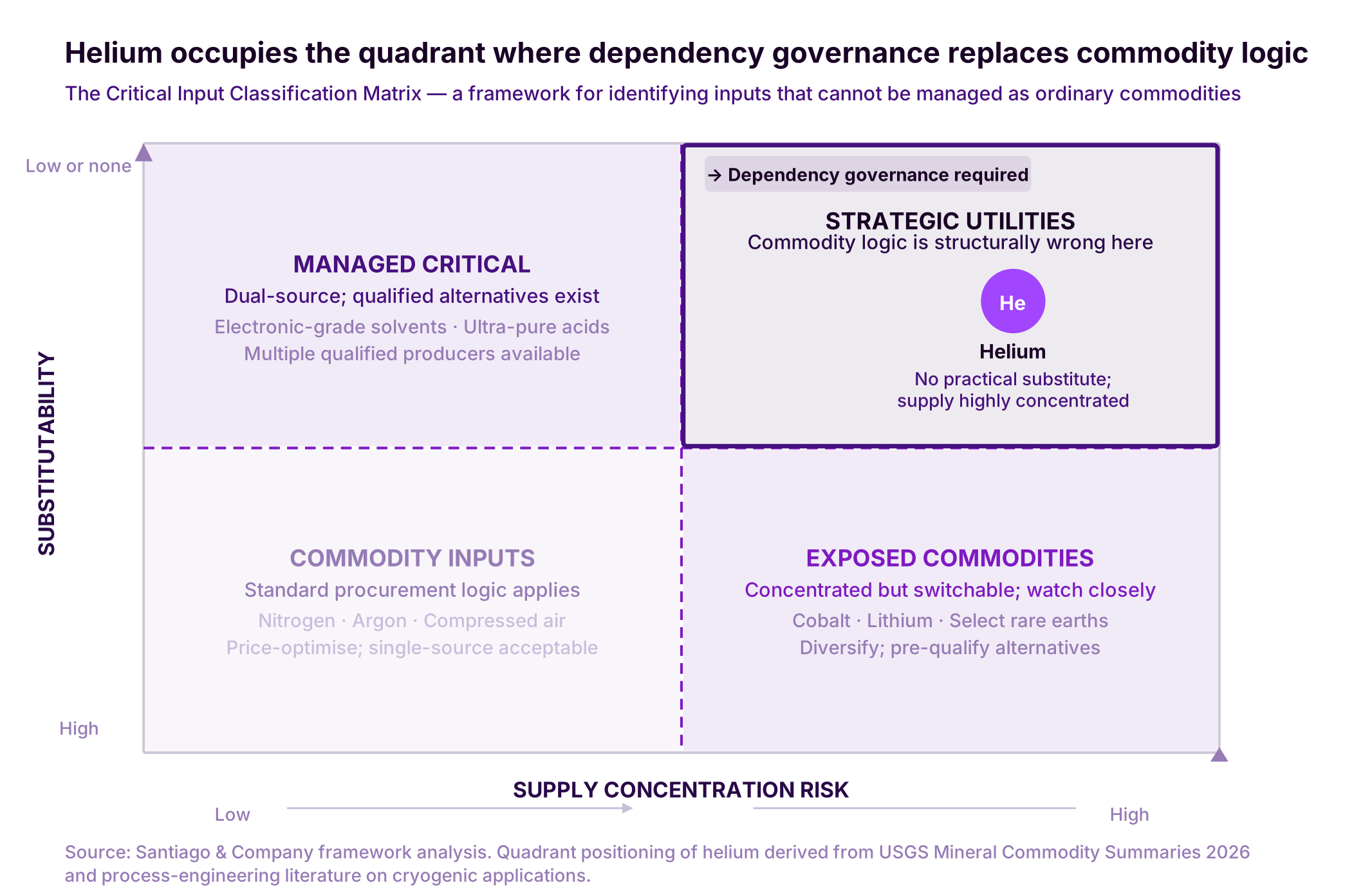
Santiago & Company’s analysis of the helium market proposes a framework for distinguishing four categories of industrial input based on two dimensions: functional substitutability (the degree to which an input can be replaced by another without production impact) and supply concentration risk (the degree to which sourcing is concentrated in a small number of geographies or producers). This framework is constructed through an analysis and synthesis of evidence from the 2026 crisis and five prior shortage events, rather than an empirically validated taxonomy with measured thresholds. Its purpose is practical: it gives a board a decision-useful lens for identifying which inputs in their portfolio require a governance posture different from standard procurement. Most industrial inputs fall into a commodity quadrant, low concentration, high substitutability, where price optimization, periodic supplier review, and modest inventory buffers are appropriate. Nitrogen, argon, and compressed air are examples. Disruption in any one source can be absorbed by others; price signals provide adequate time to respond. Helium occupies a different quadrant: high supply concentration combined with functional substitutability that is effectively zero in its most critical applications. This combination, which this framework calls the “strategic utility” quadrant, undermines the core assumptions of commodity procurement logic. Price optimization becomes secondary to allocation security. Supplier consolidation for efficiency becomes a concentration risk. Just-in-time inventory is exposed in a supply chain with no buffering capacity. The governance response required in this quadrant is dependency management, not commodity sourcing.
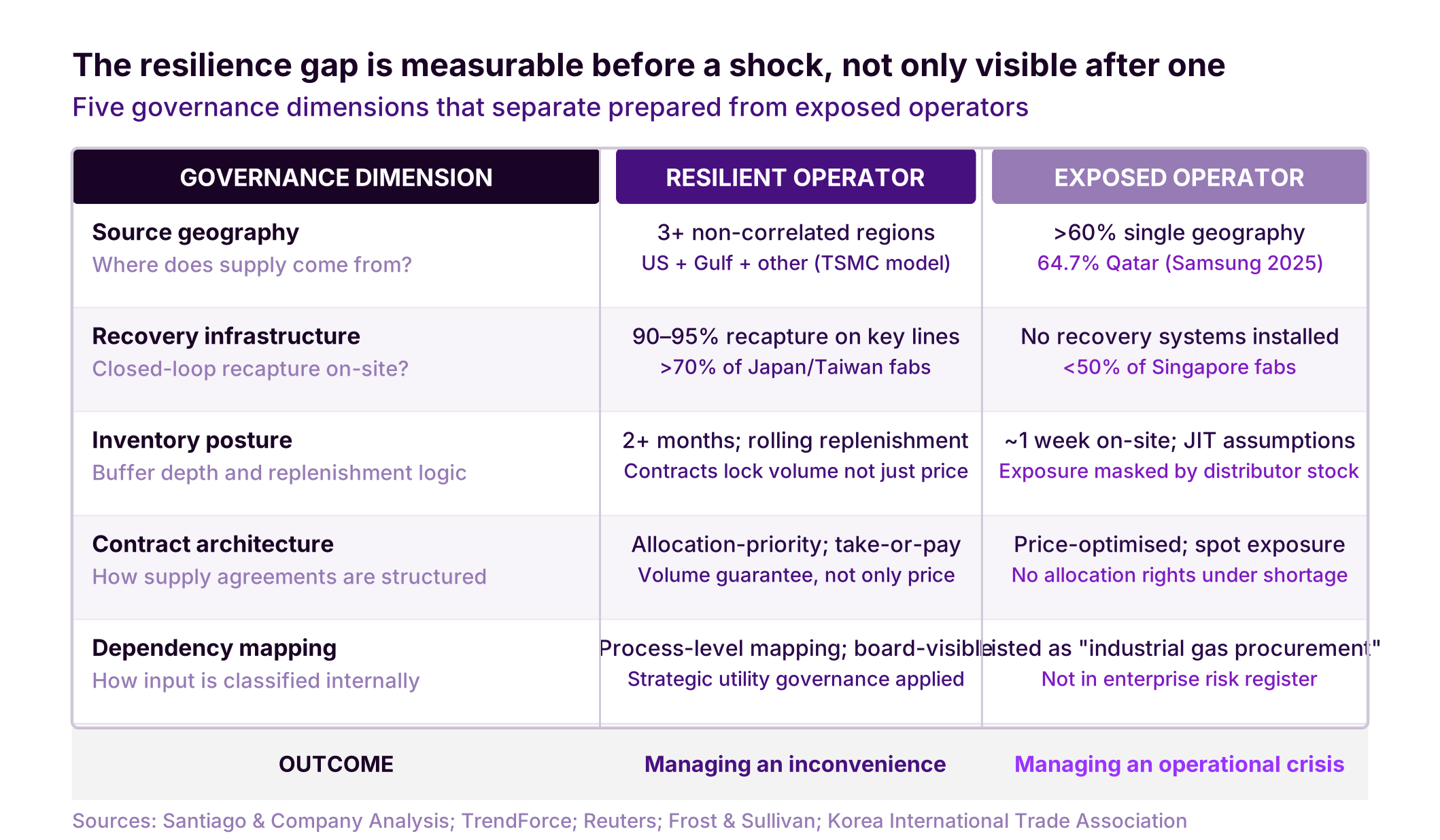
The practical distinction between commodity governance and dependency governance is measurable across five dimensions. Santiago & Company’s synthesis of the available evidence, public company disclosures, industry analyst reports, and market commentary identifies these as the dimensions that most consistently differentiate resilient from exposed operators, all of which were evident before the crisis and map onto the governance choices made years earlier.
Source geography is the single most important differentiator. TSMC’s decision to balance supply across at least three non-correlated geographies means that the loss of any single source imposes costs and logistical pressure, but not an operational crisis. Samsung’s 64.7% concentration in Qatar means that the loss of a single geography is an operational emergency. The incremental cost of geographic diversification, pre-qualifying additional suppliers, and maintaining relationships with U.S., Algerian, and Canadian producers alongside Gulf suppliers, is marginal relative to the production value at risk for a $20 billion fab.
Recovery infrastructure is the second dimension. According to Frost & Sullivan’s 2026 analysis of semiconductor helium practices, more than 70% of fabrication facilities in Japan and Taiwan have closed-loop helium recycling systems installed, capable of capturing and purifying 90 to 95% of the helium used in applications where recovery is technically feasible, compared to fewer than 50% of fabs in Singapore. These systems, manufactured by Linde, Air Liquide, Air Products, and specialty providers, cost between $300,000 and $1 million to install, depending on scale, and have historically returned investment within three to seven years at pre-crisis helium prices. At March 2026 spot prices, payback compresses to under two years, according to engineering cost analyses published by Hallam-ICS and comparable firms. Singapore, by contrast, has a lower adoption rate that Frost & Sullivan attributes partly to the later build-out of its fab base and to the historically lower priority given to specialty gas resilience in facility planning. The economic case for investment was available before the crisis; the governance framework that would have required it was not in place.
Contract architecture is the third dimension. The helium market operates primarily on long-term take-or-pay contracts, with spot trading accounting for approximately 2% of normal volume. Under shortage conditions, when distributors implement force majeure and allocation systems, the distinction between a contract that guarantees allocation priority and one that merely specifies price terms is between continued production and forced curtailment. Kornbluth has confirmed that semiconductors sit at the top of the allocation hierarchy in shortage conditions, but within that priority tier, customers with volume guarantees receive product before those without. The contract architecture decision, allocation-based versus price-only, is made long before the shortage begins.
Inventory posture reflects how an organization thinks about the physics of helium storage. Facilities with two or more months of operational buffer, maintained through rolling replenishment programs that continuously cycle stock rather than drawing it down in a shortage, have a fundamentally different risk profile from those maintaining one week of on-site supply under JIT assumptions. The physics of liquid helium mean that buffer stock cannot simply be accumulated at a fab. But it can be maintained in the distribution network through contract structures that guarantee forward allocation.
Dependency mapping the internal classification of helium within the enterprise risk framework is the upstream cause of all other differentiators. Facilities where helium appears in the enterprise risk register as a strategic utility, reviewed by the risk committee on the same cycle as energy, water, and critical minerals, made different procurement, contracting, and infrastructure investment decisions than facilities where it appears as a subcategory of “industrial gases procurement.” The classification determines the governance; the governance determines the resilience.
The current shortage will produce one of two outcomes for most organizations. Either it will resolve at an acceptable cost, inconvenient, expensive, but operationally manageable, or it will become a production-limiting constraint whose effects persist for twelve to eighteen months. The difference between those outcomes depends on decisions made in the next ninety days, not after the crisis is over.
The first decision is a strategic utility audit of the full input portfolio. This is not a procurement review. It is an analytical exercise that maps every critical production input against the two dimensions of the Critical Input Classification Matrix, functional substitutability and supply concentration risk, with the explicit goal of identifying which inputs belong in the strategic utility quadrant. Helium is confirmed. The exercise will likely surface other inputs that warrant elevated governance: specific semiconductor process gases, certain advanced materials, and inputs with structural co-production dependencies analogous to helium’s relationship with LNG. The audit should operate at the process level, not “do we use industrial gases,” but “which specific steps in our production sequence require inputs that have no practical substitute,” and should extend to second- and third-tier suppliers whose own operations may carry strategic utility exposures that propagate upstream. Any input that lands in the strategic utility quadrant requires a response from the risk committee, not the procurement function.
The second decision is restructuring supply agreements for strategic utility inputs from price-optimized contracts to allocation-secured contracts with diversified sourcing. For helium specifically, this means: a minimum of three non-correlated source geographies, with no single source accounting for more than 40% of supply; contract terms that guarantee volume allocation rather than only pricing; and explicit force majeure provisions that define priority rights rather than simply releasing both parties from obligations. This restructuring will cost more than the current arrangements. The right comparison is not the contract's cost versus the pre-crisis contract, but the contract's cost versus the cost of the production disruption it prevents. At a semiconductor fab operating $200 million EUV tools, that comparison is not close.
The third decision is an accelerated investment program in helium recovery infrastructure for any facility that does not already operate closed-loop recovery systems. The economics of this investment have changed materially. Recovery system costs of $300,000 to $1 million, against annual savings of $500,000 or more at current spot prices for high-usage facilities, produce payback periods that engineering managers and CFOs should no longer be permitted to defer on financial grounds. The sustainability case was always strong; it was frequently superseded by short-term cost optimization. The supply security case is now stronger than the sustainability case. Facilities that achieve 90 to 95% recapture on key production lines reduce their supply exposure by the same proportion, which is not a substitute for source diversification but is a material improvement in the resilience equation.
These three decisions share a common structural feature: they all require a reclassification of helium before they can be made. An organization that classifies helium as a commodity, reviews it quarterly with procurement, manages it against a price benchmark, and uses cost reduction as the primary performance metric will not make any of these investments because none of them optimize for cost. An organization that classifies helium as a strategic utility reviewed by the risk committee, managed against continuity and allocation security metrics, with operational resilience as the primary performance metric, will make all of them, because in that frame, the cost of the investments is obviously warranted by the cost of the disruption they prevent.
The reclassification is the decision. Everything else follows from it.
The history of helium shortages suggests a predictable response cycle. A shortage creates visible pain. Procurement functions request expanded supplier relationships and modestly increased inventory targets. Prices eventually normalize. Within two to three years, the lessons are superseded by cost-optimization priorities, inventory targets are reduced back toward JIT levels, and the market returns to the concentrated, no-slack configuration it had before. This cycle repeated through Shortages 1.0, 2.0, 3.0, and 4.0. It will repeat through 5.0 unless the response this time addresses the governance failure rather than the immediate supply gap.
The 2026 crisis has one feature that the previous four did not: the structural deficit created by the Ras Laffan damage will persist for three to five years, long enough to force organizations to live with the consequences of their governance choices for an extended period. Previous shortages resolved quickly enough that the cost of misclassification was a temporary surge in purchasing costs, contained within a procurement budget. This one will last long enough to affect investment decisions, production planning, and technology roadmaps. That duration is uncomfortable, but it is also the most powerful incentive ever to get the governance model right.
A board that understands helium’s position in its own operations, not as a line in the industrial gases budget but as a utility-class input with non-negotiable criticality in specific processes, will use this period to build the governance infrastructure that makes the next shortage a manageable cost rather than an operational crisis. A board that treats the 2026 disruption as an inventory problem to be solved by purchasing more expensive U.S. helium until Qatar comes back online is preparing for 2026 to happen again. At this point in the shortage cycle, both paths are still available. That will not be true much longer.
Santiago & Company's analysis draws on the primary sources cited above. All statistics are attributed to and verified against the originating source. The Critical Input Classification Matrix and the five-dimensional resilience framework are Santiago & Company analytical constructs, synthesized from the evidence base, and should be treated as a constructed analysis rather than an empirically validated taxonomy. Where the article draws inferential conclusions, particularly the governance thesis and sector-level damage projections, these are Santiago & Company’s analytical judgments and are clearly signaled as such in the text.


Aerospace and defense companies will convert record demand into revenue only by managing qualified throughput. The scarce asset is qualified throughput, and it has to be managed node by node. The approved combination of site, process, workforce, and part at the individual production-node level.
Santiago & Company announced the public release of the AI Workforce Stability Architecture (AWSA) at the United Nations WSIS Forum 2026, introducing an open framework that helps governments monitor, prepare for, and respond to the economic and fiscal impacts of AI-driven labor displacement in service-export economies.
AI is moving on a 15-month clock; governments are moving on a five-year one. For service-export economies, the winners will not be those that forecast labor disruption most precisely, but those that pre-wire fiscal and workforce responses before the evidence becomes undeniable
SpaceX does not need to disrupt the wireless industry to reshape it. By turning satellite coverage into negotiating leverage, it is forcing carriers to rethink who owns the customer relationship when coverage comes from space.