February 12, 2026

Managing Partner

Key Takeaways
AI technologies are driving a significant evolution in remanufacturing, unlocking unprecedented efficiency, profitability, and strategic advantage across industries.
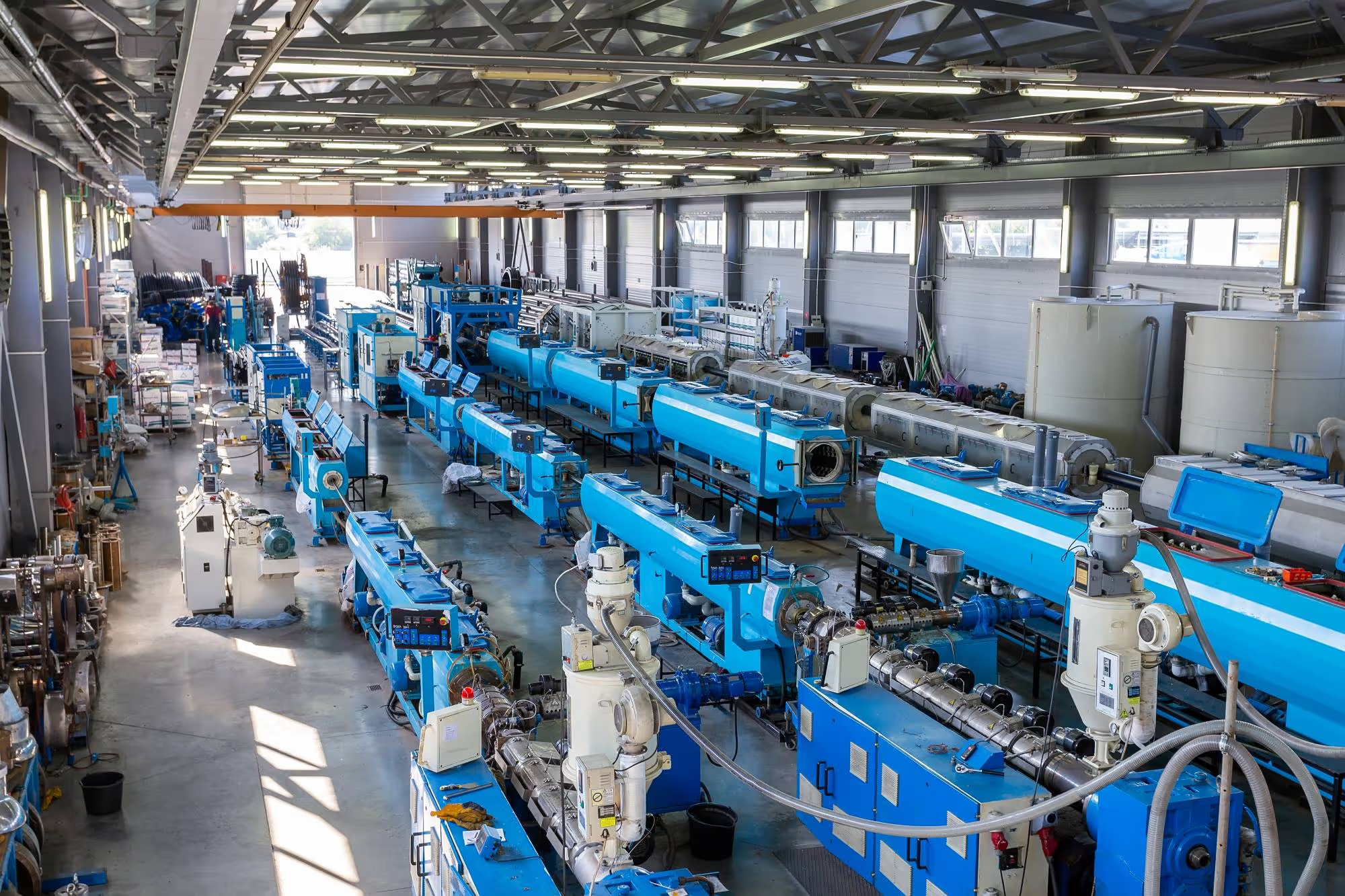
Organizations across sectors increasingly embrace remanufacturing to mitigate supply chain volatility, reach more budget-conscious consumers, and introduce high-margin alternatives. However, building or optimizing remanufacturing capabilities comes with distinct challenges. These challenges include managing extensive product portfolios (SKUs), accurately pricing diverse products, and forecasting the volume, timing, and quality of product returns (known as "cores"). AI’s growing affordability and accessibility, driven by declining costs for cloud storage and processing power and the proliferation of user-friendly AI tools, present organizations with new opportunities. Implementing AI can enhance efficiency, boost yield, and significantly improve profitability. This article examines three primary AI use cases: core forecasting, pricing optimization, and warranty management, each supported by real-world examples from sectors such as heavy-duty equipment remanufacturing and high-tech product assembly.
Unpredictable core availability poses a substantial barrier for remanufacturers, and conventional forecasting tools often lack the precision and complexity needed to manage this variability effectively. AI-powered forecasting tools can address these challenges by leveraging historical performance data. Such systems evaluate the estimated useful lifespan of parts, typical usage rates (e.g., hours or miles per day), and macroeconomic conditions by region or industry that might influence core return behaviors. This predictive approach enables companies to anticipate core availability more accurately, ensuring optimal inventory levels. Implementing AI forecasting can yield tangible operational improvements. It can reduce required core safety stock by approximately 2–4%, minimize freight costs (particularly expedited shipping expenses) by 3–5%, lower overtime labor expenditures, and prevent revenue loss associated with stockouts.
A prominent technology OEM encountered persistent difficulties matching regional core availability to demand patterns. In response, the company adopted a comprehensive AI-driven ecosystem featuring forecasting algorithms, sourcing optimization, and valuation analytics. By incorporating detailed customer insights, such as lifetime value and purchase history, as well as product-specific data, such as battery health and usage patterns, the OEM tailored personalized trade-in incentives to individual customers. This strategy significantly improved alignment of core availability, benefiting both the manufacturer and its end customers.

Pricing complexity remains a significant hurdle in remanufacturing due to vast SKU portfolios, variable product grades, and multiple condition codes. Traditional pricing strategies, often rule-based and oversimplified, frequently fail to capture the true complexity and nuances of extensive product catalogs. AI-based pricing strategies leverage sophisticated analytical tools to optimize prices across extensive SKU assortments. Techniques such as micro-segmentation, cross-SKU demand optimization, and granular price-setting at the SKU, customer segment, and product condition level allow remanufacturers to capture additional margin opportunities effectively. AI methods also mitigate data gaps by intelligently grouping similar products to derive accurate pricing insights.
Adopting AI-driven pricing optimization strategies can increase profit margins by approximately 2–4%. A specific case illustrates this potential: an independent remanufacturer managing numerous niche, low-volume SKUs previously relied on broad, rule-based pricing. Transitioning to AI-enabled pricing, the company used machine learning algorithms to pinpoint factors influencing pricing effectiveness, including brand strength, customer characteristics, and logistical complexities. Leveraging these insights, the organization dynamically set precise prices for each SKU, resulting in margin improvements of 11–15%. Moreover, the AI-driven system enabled real-time pricing adjustments across more than 140 million unique parts.
Remanufacturing warranty management involves complexities driven by massive volumes of unstructured text data and a wide variety of SKUs. Generative AI-powered large language models (LLMs) excel in identifying recurring patterns in warranty claim documentation, extracting actionable insights, and automating detailed reporting processes. Gen AI significantly improves warranty cost management. Potential savings range between 5–10% through early identification of recurrent issues, proactive problem resolution, and enhanced collaboration between warranty management teams and research and development (R&D) departments.
A global OEM striving to increase market share in the competitive U.S. market provides a noteworthy case. By analyzing warranty claims using generative AI, the company identified prevalent long-term wear patterns of remanufactured components. Insights from this analysis informed targeted R&D efforts, enhancing component durability and reliability. This led to tangible customer benefits, including reduced downtime (up to 7% less maintenance time required) and significant internal cost reductions (a 25% drop in warranty provisioning expenses). Ultimately, this approach allowed the OEM to position itself as a premium provider in its market segment.
While the technological components of AI, algorithms, and data analytics are crucial, organizations must recognize the equally critical importance of broader organizational readiness. Santiago & Company's extensive experience suggests that remanufacturers achieve the most significant long-term AI value when they invest equally in organizational capabilities, alignment, and structured change management alongside technology adoption.
Successful AI integration requires organizations to clearly define and prioritize high-impact use cases to avoid diluting resources. Securing executive sponsorship ensures AI initiatives remain closely aligned with organizational strategy and receive the necessary resources and commitment. Frequent executive engagement through ideation and strategic alignment workshops further reinforces a culture of data-driven decision-making.
Organizations should conduct thorough assessments of their current capabilities, evaluating talent, organizational structures, operating models, and roles, to identify necessary adjustments upfront. Creating a comprehensive and realistic implementation roadmap establishes clear milestones, resource allocations, and accountability measures. Additionally, maintaining momentum and enthusiasm throughout the change management process by consistently highlighting and celebrating incremental successes helps reinforce organizational commitment and facilitates smoother adoption.
Ultimately, AI offers a profound, transformative opportunity for remanufacturers. By strategically harnessing advanced analytics, organizations can effectively overcome longstanding operational challenges, unlocking significant efficiency gains, margin enhancements, and competitive differentiation. Remanufacturers that seize this opportunity today will establish themselves as market leaders in the ongoing remanufacturing revival.


Aerospace and defense companies will convert record demand into revenue only by managing qualified throughput. The scarce asset is qualified throughput, and it has to be managed node by node. The approved combination of site, process, workforce, and part at the individual production-node level.
Santiago & Company announced the public release of the AI Workforce Stability Architecture (AWSA) at the United Nations WSIS Forum 2026, introducing an open framework that helps governments monitor, prepare for, and respond to the economic and fiscal impacts of AI-driven labor displacement in service-export economies.
AI is moving on a 15-month clock; governments are moving on a five-year one. For service-export economies, the winners will not be those that forecast labor disruption most precisely, but those that pre-wire fiscal and workforce responses before the evidence becomes undeniable
SpaceX does not need to disrupt the wireless industry to reshape it. By turning satellite coverage into negotiating leverage, it is forcing carriers to rethink who owns the customer relationship when coverage comes from space.